During this module, we were asked to examine the inner workings of the Wikipedia entry on digital humanities. Explicitly using the Talk and History pages to discover new information. While I have used Wikipedia for many years, I had no idea about the 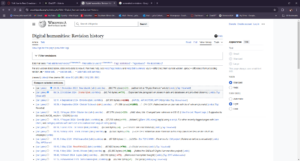 immense knowledge one can learn from diving deeper into the page. The history page, in particular, shows the user the revision history, as the included image shows, but it also shows who and what has been added. The revision history is essential to track how the page has changed and what and who is adding items. As the following image shows, users can also access who has contributed the most and what they said within the history. One can also click on the user’s biography to find out more about the perspective that the author is adding. One can determine pretty quickly whether the authors are someone who should be adding to the page or not.
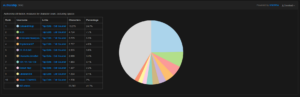
Beyond revision and authors, the history sections show the page’s development over time. Accessing pages familiarizes users with crucial information about how that page has changed over time and, most importantly, how the field has changed. This includes when significances occur throughout time, like the release of new software or a new medium. Digital humanities has changed immensely even in the last few years, and the Wikipedia page highlights this.
The page’s talk aspect, as shown in the image below, highlights the specific topics editors find to be of the utmost importance.
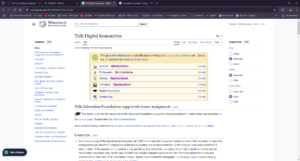
History and literature are listed as a high priority, showing what is currently emphasized in digital humanities. The talk page also shows what sources are being used and what users are debating should and should not be included. As the image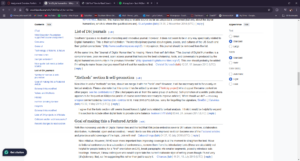
highlights that various discussions are happening regarding other sources and methods. The talk page allows the users who contribute often or rarely to engage in communal conversation to improve that page and create the best version to share with the public.
Deconstructing a Wikipedia page not only assists in gaining a better understanding of how Wikipedia pages are created and edited but also allows the user to understand who is contributing to the page. Since anyone in the public can edit, it causes misinformation and incorrect assumptions, leading to AI’s use for crowdsourcing knowledge. After evaluating and testing ChatGPT, I found that AI tools pull quite a bit of information from Wikipedia pages. This creates several issues if incorrect information is shared through Wikipedia; it is now disseminated through another source rather than just Wikipedia. Not to mention, some users could deliberately create misinformation to be shared throughout the world to further their motivations. While Wikipedia and ChatGPT can help find quick, straightforward information, one should be extremely careful when using it for more complex subjects as it can easily mislead.