Thinking about Historical Thinking Portfolio Post

Of the many challenges of our profession is thinking about history and mastering how to challenge your students, and sometimes your peers, to better understand history. As Sam Wineburg states,  historical thinking is an “unnatural act,” as we must understand our biases and realize our shortcomings.  Even someone studying history in graduate school for the past four years, there is always something new to be learned or examined. It is between the two principles of viewing the past as familiar and as strange. Also, the dichotomy of empathy versus distance, using the past and being transformed by it. This week’s readings highlight the importance and complex understanding of how to view and study history. History is about conceptualizing, cooperation, learning, and critical thinking; we should not be comfortable studying history.

One of the first concepts to examine when studying or thinking historically is the concept offered in Sam Wineburg’s work on “Historical Thinking and Other Unnatural Acts,” which explores the complex understanding and practice of historical thinking. Within his work, he emphasizes three perspectives: those of a high school student, an elementary school principal, and a historian. Having grown up the child of a principal, teaching college freshmen, and working in the historical field, I feel connected to each interviewee.  Each had their unique understanding and analysis of what they saw as necessary, particularly as it connected to the subject they were evaluating. The high school student tried to apply his knowledge and empathize with the historical subject matter. With this, the concept raised that in historical thinking, “we must consider the possibility that they drew differently because they saw differently, and that there is something different about this way of seeing what is irrevocably lost.” (Wineburg 493). With the elementary school principal, Wineburg highlights the dependence that history has relied on textbooks to convey a single narrative. It has slowly crept back into our thinking, even when trying to turn away from this. Finally, the historian understood that perceived truth in a subject matter that may be well known to you will always be areas outside of your knowledge. The historian’s job is to view the past and not label it, but learn from it.

Another factor closely tied to the Wineburg article is the article by Wineburg, Smith, and Breakstone. Again, this study felt very personal to me as I have worked directly with students in an introductory survey course and upper-level history students. I have seen some of the same trends in the lack of understanding and complexity of ideas within history classes. This connects closely to figuring it out versus finding out questions. When I try to offer my students questions that require figuring out, or those that require critical thinking, they struggle. However, they do far better when I give them simple questions about finding out.

This discussion of the complex nature of studying and understanding historical thinking has created questions for me to examine throughout this class. It has also allowed me to understand better and challenge my undergraduate students.

Questions

  1. How can I help my students better understand that history is not just a static series of events but something that requires empathy and distance?
  2. What are some of the best means of teaching and sharing history? How can I get my students to emphasize and understand the figuring-out side of history?
  3. As an educator and historian, how can I convey to my students the importance and uncomfortable nature of history, and how can I learn from their ideas and conceptualizations that differ from mine?
Introductory Blog Post

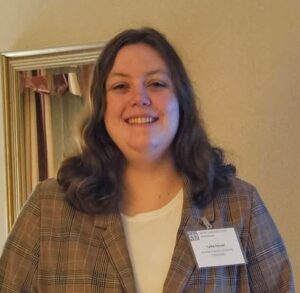
Hello, everyone. My name is Lydia Pensel. I just finished my second year as a doctoral student at Southern Illinois University. I will be taking my comprehensive exams this coming fall. My main subject area of study is British history, emphasizing the Victorian era. I am also the coordinator of our undergraduate podcasting project. Besides this, I am currently working in our college’s Center for Virtual Expression, which specializes in sharing and expanding educators’ and students’ understanding of Artificial Intelligence. With this, we emphasize that AI should be used in an ethical manner and how this can be done. We also give the instructors those tools to assist their students on how not to use AI rather than their own work.

Regarding my interests in digital humanities, I have several key areas, such as using Omeka and other forms of digital scholarship to share my research and knowledge with the greater public. Since a very early age, I have loved history and wanted to share it with everyone, particularly my students as an educator. I have really enjoyed the previous courses in this program, as they have created many questions within me about how I can expand my own research to fit within digital scholarship. Some of these questions are: how can I share my knowledge of the digital humanities with my coworkers and professors so that they might better understand its use? Also, how can I use these technologies and ideas to educate my students and future students better? Overall, I have always been highly interested in technology and finding a way to merge my passion for history with my love of technology.

Regarding my goals for this class, I want to see how I can integrate aspects of the digital humanities to teach my students better. Beyond this, as someone who deals heavily with expanding and educating others on AI, I am curious about how to make things more AI-proof, as AI is not always the best option. Overall, I am just very excited about how to better understand the use of the digital humanities in my teaching. As for what types of teaching I am interested in, I am generally interested in educating everyone. Right now, I mainly focus on university education, and that is why I am pursuing my current degree. Not to mention, collaboration with coworkers is also important. But, as last semester’s class shows, I am also interested in educating the general public to understand history and its importance better, and I wish to share my knowledge with the world.

I look forward to collaborating and learning with all of you this semester!

Blog Post on Process

As we begin wrapping up this course, it makes me consider what I learned. This course shifted the way I think about historical work entirely. What started as something unfamiliar quickly became an opportunity to explore new ways of sharing history through accessible, creative, and engaging public platforms. Designing and building a digital prototype showed me that history is not just found in books or archives. When paired with thoughtful design, people can interact with it directly, inviting participation rather than just observation.

Building the prototype required me to think beyond my usual role as a historian. I had to consider the responsibilities of a curator and communicator as well. Every decision, from structure to audience to visual layout, had to be made with clarity and accuracy. That balance was not easy to strike, but it forced me to develop a new set of skills that I now see as essential for historians working in the present day. Turning complex historical material into something open and engaging for the public was more complicated than I expected, but ultimately more rewarding. Making history accessible does not mean simplifying it. It means meeting people where they are.

What also stood out to me this semester was how much digital public history is shaped by collaboration and ethical decision-making. The course pushed me to think carefully about which narratives are told, whose voices are included, and what responsibilities come with sharing history in public spaces. I will continue to ask these questions in future work. More than anything, this course expanded how I define historical practice. Public engagement is not an afterthought or a side project. It is a key part of the historian’s work. I leave this class with a finished project and a more profound sense of purpose in making history matter beyond academic spaces.