As a child of two educators, I have always found museums to be a constant attraction. Nearly every vacation I took as a child involved some museum or historic site. Museums and historic sites offer a glimpse into the past in a relatable and easy-to-understand way. That is why when I found out that our assignment for this week was to review a physical and digital historic sight or museum, I was very excited to visit the site to review. The site I chose to review for my comparative analysis is the Missouri History Museum in St. Louis, Missouri. I have visited this site before this analysis, but it was good to see the museum again in a different light.
Physical Site: Missouri History Museum
The Missouri History Museum, while not overly large, has other in-depth exhibits, so I focused on the permanent exhibit that has recently been completely renovated, “The 1904 World’s Fair.” The quote below greeted me right outside the exhibit entrance near the Thomas Jefferson statue.
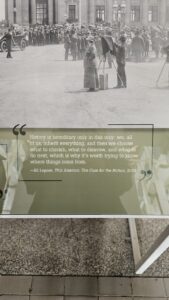
The exhibit has two components: the main exhibit and the rotating exhibit in the back of the main hall. The temporary exhibit changes every two years and is entitled “The World in St. Louis.” The first thing you experience when you walk into the exhibit is feeling like you are being transported into the fair itself. It is clear that the interpretation of the exhibit is to make the guests feel that they are a part of the fair and its history. This sense of bringing one into the fair does an excellent job of transporting the mind back to 1904 and the implications of what the fair meant for the city of St. Louis. It becomes clear that the exhibit’s mission is to give the visitor a greater understanding of the significance of the World’s Fair to St. Louis and the process that hosting the fair meant. The fair was not just some tiny city fair but encouraged, acknowledged, and spread ideas worldwide. From the beginning of the exhibit, it is clear that the audience of this work is to engage children and adults to understand better some of the history of St. Louis and the World’s Fair project. This was the case the day I visited as there was a nice mix of adults and children, with more adults present, but I see this largely due to the fact the kid’s play area was across from the exhibit.
There is a timeline that traces the exhibit on the wall, which begins to the right, and makes a semicircle to the left. In the center of the exhibit hall is a large model of what the fairground looked like in 1904, and every few minutes, a projector displays the modern city of St. Louis over the map for the viewer to situate themselves. Even with the timeline, however, the flow of the exhibit does not provide singular viewing, as there are no clear instructions on where to begin, mainly due to the model disrupting the flow. Once the viewer starts, it becomes clear how vital the fair was to the city and how elaborate the planning was. Some of the artifacts that are on display that the viewer sees right away are cultural representations of the fair, particularly a display on the famous 1944 movie Meet Me in St. Louis, starring Judy Garland. The picture below represents her wardrobe from the movie. These were temporarily on loan during my visit.
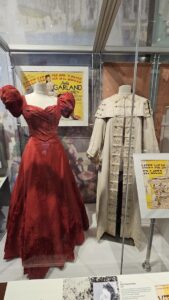
However, as the exhibit continues, other artifacts are displayed, such as governmental documents approving the fair, the commirative metals sold to raise money for the fair, and artifacts from various countries exhibits. The country exhibits highlight how much the world contributed, not to mention the different lectures and activities the fair provided. The information about the exhibited items is supplied on plaques in front of each display case that houses the items. Various fun facts throughout are also about different aspects of the fair, mainly the famous Ferris Wheel, which is used to catch the eyes of younger guests. This exhibit does not contain many interactive features, with only one present on both ends of the model. It has a collection of historical pictures of various fair phases, which is interesting for older viewers but not for younger visitors.
As one continues, they are drawn to the furthest and temporary exhibit, “The World in St. Louis,” which provides facts about the countries that contributed, as the pictures below show.
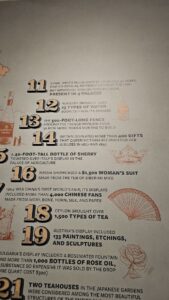
The facts about the British contribution were exciting due to my research on Queen Victoria. Along side this view, there is also a large selection of porcelain vases and paintings that many had commissioned and purchased.
Overall, as a native Missourian, I found the exhibit to be fascinating and informative. However, there are a few issues with the project as well. The most significant being that there were no docents or staff along the way to assist guests in better understanding the museum. The only staff member I saw manned a desk at the entrance, and that was it. Since the museum is a not-for-profit, this could be why there were not many to assist. Besides this, I also think the exhibit flow needs to be reconfigured, especially since the flow is confusing. If there were a more interpretive sign or staff member pointing the way, this would help tremendously. I must say that this exhibit is a vast improvement over their previous exhibit. Despite my criticisms, this is still a valuable and much-needed free resource disseminating history to its many guests.
The website is similar to the actual museum, as it is a medium of promotion for attracting visitors. However, the museum website is also in conjunction with the Missouri Historical Society, which adds more research and takes away from the overall impact of the museum. The website attempts to embody the argument that not only is the history of St. Louis important, but the 1904 World Fair is also a turning point in the history of the city and the state of Missouri. It also seeks to examine the fair in terms of many multicultural interpretations from the various exhibits. Beyond this, it aims to explore the lasting impact the fair created and how that legacy lives on until this day. The website’s design states in clear and straightforward language what the exhibit’s mission is, and it also creates the interpretive point of view that is to reintroduce the fair and all of its glory.
The flow of the website is relatively straightforward as there is a dedicated museum page that allows the viewer to plan their visit or look at the permanent exhibits. It also links to the collection of digitized artifacts held by the Missouri Historical Society. This aspect is more clearly aimed towards researchers and historians who wish to use the resources provided by the historical society. These are not to be found or seen at the physical museum and are unique in the digital location. The user can also click on the various exhibits, particularly concerning the World’s Fair, to better understand the exhibit and what it entails. This aspect of the digital site caters more to the general public and those who wish to plan their visit to the museum. This simplistic nature of the website also allows for a singular flow for the user. With this singular flow, the viewer is encouraged to not only plan a visit to the museum but also provide helpful blog posts and articles that allow for a better understanding of what some exhibits entail and engage them to visit the museum. While direct contact with the curators and organizers is not directly encouraged, there is a generic Contact Us link that the user can utilize. The digital experience is exciting and helpful for a visit. Still, since it is directly connected to the Missouri Historical Society, it confuses what one can expect. Separating the sites would help immensely with the user’s experience.
Comparative Review and Final Thoughts
Overall, the two sites offer a more profound understanding of the significance of the 1904 World’s Fair for the city of St. Louis. Both provided an accessible experience for all ages and allowed viewers to interact, even if it was slight, to gain a clearer understanding of history. Even if the museum is primarily dedicated to the history of St. Louis and not the state of Missouri, this does not take away from its importance as a free institution and place of learning for the community and state.