(Re)Defining Digital Humanities

When I started this class, I had a very vague understanding of the digital humanities. One of our first activities was coming up with our own definition of the digital humanities. My definition was an interdisciplinary field of study that draws inspiration from the humanities and uses technological computing to expand, disseminate, and improve previous research and share these ideas with the public. As I have directly worked with digital humanities throughout this semester, there are clear areas in my first definition that were correct in my assumptions. The digital humanities are directly related to the field of humanities, which is continuous throughout this semester as we looked at projects that utilized works mainly from history but other fields, such as anthropology and sociology. When engaging with the humanities also leads to an interdisciplinary nature that allows for diverse ideas across many fields. Throughout this semester, technological computing was also highlighted in many different ways, particularly in creating data visualizations and data analysis. This semester has also emphasized expanding and sharing digital research with the greater public. One of the core tenets of digital humanities research is to share academic research with the wider public so they can understand and value it. Sharing ideas with the public is a central aspect of digital humanities.

I would keep some aspects of my definition, but I would replace or clarify some now that I have a deeper understanding since I have been directly working with the material. The first aspect that I would change is that instead of using the generic and vague term of technological computing, I would expand this and provide specifics such as data visualization, text mining, digital mapping, and crowdsourcing. By just saying the term technological computing does not show the potential and extent of what can be done with digital humanities. Not only can patterns be observed, but data can be seen in an entirely different way. Another key area that needs not only clarification but to be wholly changed is the phrase “expand, disseminate, and improve previous research.” These processes of expanding, sharing, and improving are aspects of digital humanities, but they also negate the pivotal element of creation. Digital humanities projects create new methods of research and ideas for inquiry. They might expand on previous research, but each project creates something new and different that allows others to see that work in an entirely different light. This semester has taught me so much, not only about various methods of creating digital humanities projects but also about how essential digital humanities is for the future of research. This class has become a guiding light for my future research.
Podcasts and the Digital Humanities

Podcasts are part of almost everyone’s daily lives. They not only act as a means of connection to a broader community but also allow for the dissemination of information to the wider public. I feel very passionate about podcasts because I am in charge of my undergraduate history department podcasting project, where I produce, record, edit, and publish podcasts. A podcast has so much potential that it can not be achieved within a regular medium such as text. First, podcasts, particularly historical podcasts, allow listeners to interact directly with the subjects they are learning about. This can be heard through oral histories, interviews, and other forms. As the podcast Throughlines highlighted it the episode “The Lavender Scare,” oral history interviews can be directly shared. This creates a greater intimacy with the audience and a direct connection between the listener and the storyteller. A direct oral interview can be shared, and a reading of the subject works also creates a greater connection. Podcasting also allows for those who are auditory learners to understand better information that they can not as easily comprehend in text form. Beyond this, podcasts are also critical for their ability to be shared with the wider world. One of the most essential aspects of podcasts and digital humanities is accessibility and whether the general public can find work. With a podcast, nothing is more important than sharing your work with the world. This can be shown directly in the project I work with as the undergraduates who participate in the project use their research paper to share with the world and create our own digital form of student-published journal. Their research can reach a wider audience and inform the masses with a podcast.

Podcasts not only exemplify the key factors of digital humanities projects, such as data visualization with Voyant and mapping with Kepler .gl, but they also share projects with the greater public. These projects show how digital humanities scholarship can use a multidiscipline approach to data, information, and sources to create a project with various mediums. Not to mention that podcasts and other digital humanities projects are primarily collaborative and allow for many to work on a project together. This allows for varying perspectives and critical contributions that are not the same in traditional scholarship.  Academic scholarship is outstanding for academics, but digital humanities projects and, specifically, podcasts create a means of disseminating one’s work to a broader audience and, in turn, enriching the lives of others. Intimacy in listening to a subject’s voice, such as a historical figure or just an everyday person, perpetuates the principles of digital humanities and creates something exceptional for the world.

What Can Digital Humanities Do With Crowdsourcing?

Before working specifically with crowdsourcing in the digital humanities within this unit, I was very unfamiliar with community projects such as Transcribe Bentham, which we worked with, and Zooniverse, as mentioned in this unit’s reading by Mia Ridge and her fellow authors. The context I knew of crowdsourcing was mainly similar to crowdfunding projects, where you contribute financially. Once I worked with Project Bentham and By The People, I fully understood the implications and importance of crowdsourced projects within the digital humanities.

First, transcription is the type of task within digital humanities that works well with crowdsourcing. As the projects we specifically worked with showed, using crowdsourcing to view and transcribe documents such as letters, journals, and other written material is valuable. Not only can others view things that some may have missed, but with extensive collections such as the By The People, the more hands involved make for less work for each person. This shares that collection of information with the public, allowing those who may not have much interest in the subject to learn and interact with a person’s works. Another task that works well with crowdsourcing is including data annotations, categorizing, and inputting metadata. Many museums and archives are overwhelmed with the number of items and data that need inputting; thus, if they turn to a crowdsourcing model, they can not only engage in completing these tasks faster but also gain more interest in the wider world. Finally, crowdsourcing to create oral histories and storytelling in the broader community creates a more extensive digital archive. It allows those in the general public to be directly involved in significant events while sharing their own stories. As a historian, I also have to look at the value of recording history for the future as never being a bad thing.

Another aspect of crowdsourcing crucial to the project’s success is engaging and retaining those involved. The most important key to the success of a crowdsourcing project is the user interface; if the software being used is complicated to work with, then the users will stop using it. I intercountered this directly within the Transcribe Bentham, since it was one of the first projects of its kind, the software was complicated to work with. Not only were the images not high quality, but the interface did not allow the user to engage in the work as closely as possible. This highlights how critical it is for interfaces with crowdsourcing material to be simplistic and have the required tools for the user to succeed. In the case of transcription, high-quality images are a must. Beyond the interface, another key factor is that the project needs to have clear goals and outcomes to avoid confusion about what the user is contributing to. Every project must make clear what they want to achieve and what they plan to do with the work when it is completed. Finally, a crowdsourcing project needs clear tutorials, instructions, facts, and support for the users to have all of the tools to be successful in helping the creators achieve their goals. If there are no clear instructions or a support page to assist the users, they will likely not even engage in the project. Crowdsourcing allows many different organizations, archives, and museums to interact directly with the public in a new way that allows both parties to gain and work together, which leads to a brighter future for digital humanities and humanities in general.

How to Read Crowdsourced Knowledge

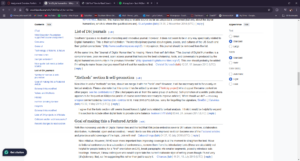
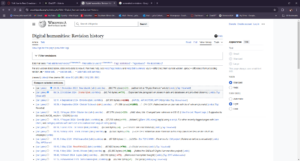
During this module, we were asked to examine the inner workings of the Wikipedia entry on digital humanities. Explicitly using the Talk and History pages to discover new information. While I have used Wikipedia for many years, I had no idea about the immense knowledge one can learn from diving deeper into the page. The history page, in particular, shows the user the revision history, as the included image shows, but it also shows who and what has been added. The revision history is essential to track how the page has changed and what and who is adding items. As the following image shows, users can also access who has contributed the most and what they said within the history. One can also click on the user’s biography to find out more about the perspective that the author is adding. One can determine pretty quickly whether the authors are someone who should be adding to the page or not.
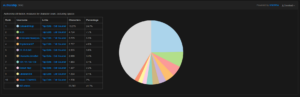
Beyond revision and authors, the history sections show the page’s development over time. Accessing pages familiarizes users with crucial information about how that page has changed over time and, most importantly, how the field has changed. This includes when significances occur throughout time, like the release of new software or a new medium.  Digital humanities has changed immensely even in the last few years, and the Wikipedia page highlights this.

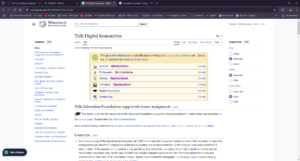
The page’s talk aspect, as shown in the image below, highlights the specific topics editors find to be of the utmost importance.

History and literature are listed as a high priority, showing what is currently emphasized in digital humanities. The talk page also shows what sources are being used and what users are debating should and should not be included. As the image

highlights that various discussions are happening regarding other sources and methods. The talk page allows the users who contribute often or rarely to engage in communal conversation to improve that page and create the best version to share with the public.

Deconstructing a Wikipedia page not only assists in gaining a better understanding of how Wikipedia pages are created and edited but also allows the user to understand who is contributing to the page. Since anyone in the public can edit, it causes misinformation and incorrect assumptions, leading to AI’s use for crowdsourcing knowledge. After evaluating and testing ChatGPT, I found that AI tools pull quite a bit of information from Wikipedia pages. This creates several issues if incorrect information is shared through Wikipedia; it is now disseminated through another source rather than just Wikipedia. Not to mention, some users could deliberately create misinformation to be shared throughout the world to further their motivations. While Wikipedia and ChatGPT can help find quick, straightforward information, one should be extremely careful when using it for more complex subjects as it can easily mislead.