Humanities Data

The ultimate question that required an answer throughout this module was: why create data from humanities sources? Ultimately, the question of data lies in what the scholar seeks to discover. By creating data from your projects, one can find many aspects not previously understood from their work. One can discover patterns, relationships, and structures that are not apparent in reading the work. As Thomas Padilla shows in our readings, creating data creates greater possibilities for understanding and studying research. Using various tools such as data visualization, mapping, or spatial analysis allows large collections to be observed and comprehended far more easily than simple analysis. Specifically, I learned how complex and comprehensive data collection can be with our work on various projects such as the Tudor Networks, the Fairfax County Probate Records, and the Early African American Film. These projects highlighted this, but directly working with the Works Progress Administration Slave Narratives project and creating data specifically really made me realize how important creating data from documents, letters, and various other sources is to create a broader analysis field. In the case of the Slave Narratives, this data adds more humanity and greater emphasis on that individual story and how it connects to a broader context. Even though I only worked with three individuals, I felt a better connection to their story when I created their data. I also understood that with the right tools and sources, data creation is not as difficult as I once thought.

The questions that the data lets you answer that other methods do not are as follows: What patterns are seen throughout the given information?  What are the shifts and trends that occur throughout? What are common themes throughout the data? By creating data and answering these questions, the understanding of the subject is far greater than that of other projects.

When a scholar creates data from various sources, transparency is always key. The first aspect is transparency about how the scholar interpreted the data, whether it excluded certain items, created a common theme with names, and how the data was digitized. Normalization and the direct mention of this process are critical for the transparency of data creation. By explicitly stating how the data was developed and what factors created the data, the scholar creating the data has less ground for potential biases. Beyond the risk of biases, scholars can craft false arguments that would cause some to create the wrong conclusion. Specifically, stating what was undertaken to create the data and what was excluded is essential to the integrity of the field and the legitimacy of the scholar.
 

Why Metadata Matters

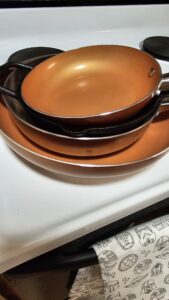
Before completing the metadata module, I had no real clue what metadata even was. I had heard the term used but had never truly engaged with it. Now, I fully understand its complexities and importance. A definition is essential to begin discussing metadata. Metadata is facts or attributes describing an item, such as a book, document, computer file, image, or artwork. These attributes are used to convey the digitized item and assist in the cataloging and processing digitized artifacts. Beyond this, it gives the item context in the greater field of research. Because of the nature of the current world, it is hard to access all material in person, and thus, the digitized image and its metadata assist immensely. In this unit, I digitized various items in my kitchen through photographs. The image below is of four skillet pans sitting on a stove. The metadata for this object is broken down into categories based on the Dublin Core metadata vocabulary. The critical pieces included are the title, the subject, a description of the photo, the source, the format, and the rights associated with the item.

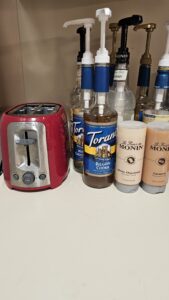
This other photo was of many of the various coffee syrups and my toaster.

Using these images, I created metadata concerning the various dimensions of the photo and attributes of valuable resources such as Tropy, where I can store all of the images and the metadata surrounding them. After exporting the metadata to Omeka, I created a cohesive and well-organized exhibit of my digitized sources and utilized the metadata. This has been an amazing learning experience for me as I have discovered all of the valuable resources available for no cost and can improve the efficiency of one’s research. Metadata gives one easy access to the rights, format, type, original location, and where the item is stored.

Metadata is essential in the digital humanities because it provides an easy means of finding crucial aspects of media included in research. The key areas of particular importance to the digital humanities are prominence information or the original location and history of the item. Without this, the item merely becomes another ordinary object. As a historian, provenance is especially important in understanding the historical context.  Another key area of essential metadata is the rights of the object. When researching, one always has to be cautious not to violate copyright and fair use, and thus, having the rights information included with the data makes it far more simplistic. Finally, understanding the creator and where the item is currently housed is essential to digital humanities scholarship. Knowing where the object was digitized and is stored helps the researcher better understand the object within the archival context. Still, it also assists in understanding if any inherent biases are present. This is crucial because these biases could potentially harm one’s research.

Digital humanities scholarship also greatly benefits from the programs Tropy and Omeka. Tropy allows for importing all objects needed to catalog and create metadata in one central location, and the interface is highly accessible for the less technologically inclined. Storing these objects and creating metadata makes one step of the research process much more manageable. Using Tropy to create metadata also allows for the export of this data into Omeka. Omeka utilizes Dublin Core metadata vocabulary that is more detailed and provides more context to the items. Beyond this, Omeka allows digital humanities scholars to create exhibits to share their resources through a digital professional environment. Omeka is also important in the metadata organization and creates another central location for the research process. Overall, using, creating, and sharing metadata through platforms like Tropy and Omeka is pivotal to the digital humanities and the future of research.

Database Review

Gale Primary Sources: Archives Unbound

Overview: 

Archives Unbound is an extensive database of digital items from primary source material aimed explicitly toward history. In terms of search options, this database uses indexes such as keywords, author/creator, document title, and manuscript number. You can also utilize the advanced search feature to narrow it down to times such as newspapers, manuscripts, monographs, what collection the item is in, and dates before, on, after, and in between. It also allows for multiple rows of searching. Beyond this, it has a topic finder and a term frequency graph that curates the search results. Little information is provided about the project’s digitization, except on the main page through the distributor.

Facts:

Date Range: Spans from the Middle Ages to twentieth-century political history.

Publisher: Gale, a Cengage Company

Publishers About Page: https://www-gale-com.mutex.gmu.edu/about

Object Types: Manuscripts, newspapers, monographs

Location of original material: Varies greatly, but some examples are Amistad Research Center, Tulane University, Cornell University Library, Library of Congress, and The National Archives (Kew, United Kingdom).

Exportable image: Yes, PDF

Facsimile image: Yes

Full Text Searchable:  Yes, using OCR.

Title list links: https://go-gale-com.mutex.gmu.edu/ps/exploreCollections?userGroupName=viva_gmu&prodId=GDSC

History/Provenance:

Original Catalog: Yes

Digitized from microfilm: Some items

Original sources: Several different archives, such as the Federal Bureau of Investigation, Franklin D. Roosevelt Presidential Library and Museum, Library of Congress, and The United States National Archives.

Reviews: Glendale Library Arts and Culture and The Gale Review

Access: Available through institutional subscriptions, primarily through universities and public libraries.

Info from Publisher: Gale, a Cengage Company

Other info: Comprehensive user guides are available, and sources are curated into specific topic areas.

Citing: The website provides an automatic citation tool that includes MLA, APA, Chicago, and Harvard styles. This can be found after clicking on each item you wish to view.


A Guide to Digitization

After reading and experimenting with digitization, I have learned many facts that dictate what can and can not be captured. Several aspects can be captured when using photography and images for digitization. First, if the item contains text, images can portray this to the viewer. Also, color can be captured through photography. Images convey an object’s two-dimensional aspects, showing the viewer a flattened view of the item.  In terms of video recording, other elements can be captured, such as the object’s sound and every side of the object. While this does not convey the full three-dimensional view of the object, it does give an understanding of all sides. Audio recordings can also capture the object’s sound without viewing it visually. While several aspects can be captured through digitization, several can not, as shown by the various activities. The first is texture; you can not physically feel an object in the digital form, so you can not determine its texture. Besides this,  digitization can not convey the smell of the object; it is impossible to decide on the scent through a digital platform. Finally, based on the kitchen photos and videos taken throughout this module, size is also tough to determine when digitizing. Size is primarily determined based on the objects in the photograph, which can be altered by zooming in or out. Therefore, digitization using images and videos can convey aspects such as color, dimensions for the most part, and sound. In contrast, these media platforms can not portray texture, smell, or accurate size.

What forms of digitization make sense with certain items indeed varies item by item. For documents or items, including text, photography makes the most sense. To be even more specific, optical character recognition (OCR) can be used to extract text from the book, manuscript, journal, or diary using the captured image of the text. Photography is also useful in digitizing paintings or drawings as these two-dimensional items are portrayed as such. Audio recording is the perfect form of digitization for oral histories, sound recordings, and music. Video captures not only the many sides of various objects but it can capture the sound with an image. Videography also captures the movement of fluid items, such as older films, performances, and oversized items that can not be wholly captured in photographs. Thus, different items require different forms of digitization based on several factors, which will portray the item the closest to its original form.

Based on the reading by Paul Conway and Melissa Terras, when working with digitized representations, one must consider several aspects, changing the perspectives of the items. The person must make several judgments when digitizing an item, as Conway portrays. First, should the item be portrayed in its original state with imperfections and in the original scene? Or should it be portrayed based on the photographer’s intent? As Terras shows, the digitization process is not only expensive and labor intensive but is also highly curated to social and political factors, which brings into question diversity.  Thus, when the person working with the original material makes the choice they do when digitizing, it creates hurdles for the viewer to determine the accuracy of the item being viewed and whether it can be used for the proposed purpose. What we see in a photo may look one way to us, but viewing the original item is entirely different. Objectivity in digitization is an essential piece that must be understood when using digital resources. Digitization is not merely taking a picture or video of an item. Many considerations are undertaken before and after the process are required throughout the process.


Europeana

Europeana

Rights Statement

Trying to move away from purely American public domain sources, Europeana provides research on European digital culture. In the collections funded by the European Union, one could find almost any type of media imaginable. Whether one is looking for manuscripts, artwork, consumer culture, or even the history of industrialization, Europeana provides directly curated collections. Not only does the website serve as a vast repository of public domain images, but it also provides essential media tools from key data sources. When researching media for my previous research projects, Europeana provided me with essential information and media on Queen Victoria from some of the most prestigious institutions.

Library of Congress

Library of Congress

Rights Statement

The Library of Congress’s free and reuse page creates an easy environment for scholarly research, including resources such as images, manuscripts, musical scores, films, and millions of other digital artifacts. Not only are the vast resources accessible, but they are either in the public domain or have been approved by the copyrighters for public use. This means that one can use the website without worrying about breaking copyright law. The Library of Congress website is also broken into research-grouped collections that provide the researcher with an extremely approachable means of conducting research. When searching for my research for my dissertation, I was able to find over forty thousand items to use.


Smithsonian

Smithsonian

Rights Statement

The Smithsonian website provides the public with millions of images, audio recordings, and three-dimensional and two-dimensional objects. Not only does the Smithsonian provide these resources through open-access media, but they also provide resources from their more than twenty museums and other valuable research resources. Beyond the vast amount of material provided, the Smithsonian also provides insights into historical subjects and cultural movements, and it even analyzes popular media throughout time. In terms of my own research on Victorian-era British pet ownership, I was able to find hundreds of images to use for future research. The Smithsonian website and its vast amount of resources provide free, accessible media tools for any research imaginable.


Prelinger Archives


Prelinger Archives

Rights Statement

In the Prelinger Archives, one can find a vast resource of films whether they be pertaining to advertising, educational, or even amateur films. Having more than thirty thousand items in their collection, one could find almost anything they want. If one is interested in historical war films or film examples from other countries. The collection dates all the way back to 1903 and has films that are from the present as well. Beyond the historical value of the Prelinger Archive, the preservation of culture is also present and can be shared freely in the public domain. Historians, educators, and researchers alike can use the many valuable resources.


NASA on The Commons

NASA on The Commons

Rights Statement

On this section of the website, Flickr, NASA on The Commons provides the public with many different media forms pertaining to the history of NASA. These images, videos, and films are offered free of use to the public for educational and news publication purposes. With various images ranging from the very beginning of space exploration to the present, this site seeks to inform everyone about the intricacies and complexity of space exploration. Beyond collections of each varying space mission, other collections include important subjects such as Women in Space and the multiple research centers that fueled NASA throughout the decades. They even have collections of photos of missions to Mars.

J Paul Getty Museum

J Paul Getty Museum

Rights Statement

This website provides images and other resources from the John Paul Getty Museum and Getty Center collections. Within these collections are art pieces from many different time periods, some dating all the way back to before the common era. One such piece is a sculpture of the god Hercules from Ancient Rome. Another is a painting by Vincent Van Gogh entitled Irises. The website provides images of several pieces of artwork for the public to engage and interact with. The over eighty thousand images of the artwork and other features provided by the Getty Museum are allowed to be shared by the general public through Creative Common License, which means they can share the importance of art through their images.