Final Project Update

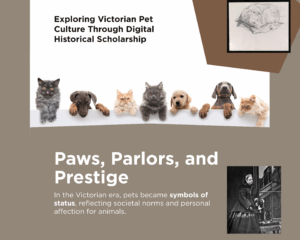
My final project, Paws, Parlors, and Prestige: A Digital Exploration of Victorian Pet Ownership in Britain, is a digital exhibit designed for upper-level undergraduate students and the general public. It examines how pet ownership in nineteenth-century Britain reflected and reinforced ideas about domesticity, class, gender roles, and empire. By curating historical images, primary sources, and interpretive texts, the project shows how pets were not just companions but also cultural symbols woven into the fabric of Victorian identity.

I have completed a portion of the research and digital infrastructure. Due to being on vacation the past week, I have not made as much progress as I would have liked, but I plan to rectify this moving forward. I am still using my discretion and detail to determine what exact images, paintings, and text will be included. These materials will be grouped into thematic sections such as “Imperial Creatures,” “Pets and the Domestic Ideal,” and “The Royal Influence,” each with interpretive captions grounded in both scholarly and public history approaches. The Omeka exhibit site is under construction. I have begun drafting exhibit pages and the infrastructure, and have also been thinking carefully about how to use visual design and structure to guide viewers through the exhibit in a way that encourages historical thinking while remaining accessible.

I plan to finish writing and editing exhibit text in the coming weeks, ensuring clear historical framing and audience engagement. I will also create metadata for each primary source to enhance accessibility and search functionality. I plan to add a brief narrative guide to orient users and incorporate interactive or reflective prompts to deepen user engagement with the material.

Exploring this week’s digital history projects and student reflections offered valuable guidance. The Visualizing Emancipation project reminded me of the power of thematic mapping and data layering to convey historical complexity. While my project is not map-based, the visual logic of that exhibit made me reflect on how to organize my own content so that users can explore patterns across time, class, and imperial geographies. The 1898 War Cartoons exhibit demonstrated how visual culture can communicate subtle and overt ideologies. That project helped me think about the didactic potential of Victorian pet portraits, advertisements, and images that carry layers of social meaning beyond their surface cuteness. Becoming Richard Pryor was especially helpful in showing how localized personal stories can speak to broader historical forces. I will apply this model by including case studies like Queen Victoria’s dogs to reveal broader Victorian values surrounding status and sentiment. Finally, listening to former students reflect on their digital history work reinforced the importance of ownership and creativity in public-facing projects. I appreciated their emphasis on storytelling and their openness about the challenges of translating scholarly knowledge into digital form. Their reflections encouraged me to trust my historical voice and to prioritize narrative clarity and user engagement over exhaustive academic detail.
Media Consuming and Creating Post

The objective of a history educator involves using film to guide students toward deeper engagement with historical construction and representation while avoiding simple date memorization. Film is a practical entry point for this work because it presents interpretations of historical events. Through classroom film screenings students learn to question narrative content and how different perspectives affect storytelling and what influences and evidence shape these narratives. These are all central to historical inquiry.

The historical drama Iron Jawed Angels represents an effective educational tool I would use to teach about women’s suffrage in the United States. The story of Alice Paul and Carrie Chapman Catt serves as the main focus of this historical film. The story integrates contemporary storytelling methods, creating beneficial contrasts between historical elements and modern presentation techniques. The conflicting aspects between past and present content are what I want students to investigate. What motivated filmmakers to select their particular storytelling approach? Which elements does the film show and which parts does it omit? The film includes specific elements that direct our interpretation of the suffrage movement. The assignment pairs the film with authentic historical documents, including suffragist letters, newspaper articles, and political cartoons. The assignment allows students to assess visual representations against historical records to determine source reliability and intentional use.

I choose The Young Victoria and Suffragette to represent British history in my teaching. These films provide multiple chances to examine how the monarchy, political reforms, and women’s political empowerment appear in history. The film depicts Queen Victoria’s beginning years as monarch while exploring constitutional monarchy and royal court politics and the social dynamics of power based on gender. This film will trigger classroom discussions about the boundaries of royal power, image creation, and marriage as a political tool. This film shows how working-class women were central to the Edwardian suffrage movement. The movie demonstrates the conflicting forces between social status and political activism and gender identity. Students can analyze political power struggles through time and class by examining these films with parliamentary debates, protest literature, and contemporary newspaper accounts.

I see scholarly digital storytelling as a teaching method that empowers students to comprehend the interpretive elements of historical research. Through tools like StoryMapJS, TimelineJS, Omeka, and making videos like we viewed,  students develop skills to gather sources and create narratives while considering how the project format affects meaning production. Digital stories demand that students consider audience needs while building structure, accessibility features, and visual communication techniques. The process requires that students establish their key points and determine which information to remove while developing their material arrangement to demonstrate their historical argument.

Students studying Victorian Britain would develop digital exhibits or videos about pet ownership in their coursework. Students could analyze the representation of pets through newspaper articles and maps to explore their relationship with social class, gender norms, and imperial culture. Through this work, students would practice their abilities to conduct close readings and analyze sources while interpreting historical information. Through this experience, students would master digital competence, creative skills, and learning to present information effectively to public audiences. Such skills provide essential capabilities to anyone who aims to present historical content to broad public audiences.

Through their film and digital storytelling exploration, students gain awareness about the changing nature of historical records. Historical information is a dynamic system that depends on interpretive choices made during construction. The chosen methods enable students to investigate narrative development processes as they learn to develop their interpretive work. This is what I want to cultivate in the classroom. Knowledge acquisition about past events takes place alongside developing expertise regarding constructing that historical understanding.

Film Review: Iron Jawed Angels

Iron Jawed Angels, an HBO historical drama released in 2004, was directed by Katja von Garnier and produced by HBO Films, with Marisa Yeres Gill, Len Amato, and Patricia Clifford serving as executive producers. I accessed the film through the Max streaming platform. It centers on the American women’s suffrage movement in the 1910s by following the work of Alice Paul and the National Woman’s Party. The film draws on historical materials, including Paul’s correspondence, public statements, and accounts of the suffrage campaign. The events are shaped through dramatization rather than strict adherence to the historical record.

The film’s central concerns include political expression, civil disobedience, generational tensions within reform movements, and the intersection of gender and power. The narrative traces the conflict between moderate and more confrontational strategies for achieving political change. It emphasizes the division between Alice Paul and Carrie Chapman Catt, presenting Paul as a disruptive but necessary figure in the push for a federal amendment. The film links bodily autonomy to political rights through its depiction of incarceration and forced feeding, positioning the female body as a site of state control and resistance.

The film reasonably accurately presents major events, including the 1913 Women’s March on Washington and the hunger strikes at Occoquan Workhouse. It privileges emotional engagement over historical complexity. The use of modern music, costuming, and compressed character development, prioritizes accessibility at the expense of nuance. The role of Black suffragists, particularly Ida B. Wells-Barnett, receives little attention. The decision to sideline their contributions simplifies the racial dynamics of the movement and omits a crucial aspect of its history.

One of the film’s most effective moments occurs between 13 and 18 minutes, during the depiction of the 1913 suffrage parade held just before Woodrow Wilson’s inauguration. This sequence juxtaposes coordinated banners and disciplined marchers with the visible hostility of the crowd. It captures the physical risk involved in women asserting political presence in the public space. The camera focuses on Alice Paul’s unflinching expression as she confronts verbal abuse and physical aggression. Her body becomes both a target and a symbol of defiance.

Another key moment appears between 01:39:00 and 01:44:00, when Paul is force-fed following her hunger strike in prison. The sequence is visually and emotionally unsettling. Paul is restrained while the feeding tube is inserted, and her muffled protests are left unfiltered. The scene accurately portrays the brutality of state efforts to silence political opposition. It reinforces the connection between female embodiment and coercive authority.

I would include Iron Jawed Angels in a course or exhibit focused on gender, protest, or American political culture.  I have shown this to one of my classes previously; rewatching inspired me further. The film offers a visually compelling entry point into the suffrage movement, particularly for students unfamiliar with the period. I would frame the movie as a dramatization and encourage viewers to identify where it diverges from historical documentation. Before screening, I would ask students to consider the range of strategies used by reformers and how internal disagreements shaped the direction of the movement. Afterward, I would raise questions about narrative focus. Whose voices are centered? Whose are missing? What does the film suggest about the relationship between personal sacrifice and political change? I would also direct students to primary sources, including letters, organizational records, and visual materials, to ground their analysis in the historical record.

Although Iron Jawed Angels does not offer comprehensive historical accuracy, it successfully translates the urgency and stakes of the suffrage movement for a modern audience. When paired with critical discussion and supplemental sources, the film remains a valuable teaching tool that can deepen students’ understanding of the movement and its broader political context.  Since rewatching and reconceptualizing, this allows me to think further about how to show the film to potential students.

Images: Third Piece of the Puzzle

After taking some time to consider deeply what I wanted to accomplish with my project in terms of the audience, I have thus begun to research and create some artifacts. Since I did my public history project for my last class on a similar subject, I am thinking of ways of creating a distinction between this project and the previous project. I can most likely use a few sources from that project, but ultimately, I want this project to be completely independent of the previous project.
In terms of research, I have been using various websites such as the Victoria and Albert Museum, the Royal Collection Trust, the British Library, and the British Newspaper Archive to find various sources that allow me to narrow my focus a bit. I have primarily been examining primary sources such as images, paintings, etchings, and newspaper articles. This is not set in stone and can change often as the research leads me to another direction. The main question I have right now is what themes I want to pursue and categories that can and do relate to the viewers. This has been my challenge thus far, as I know pets and class is one category, but the others have not been fleshed out as much. In terms of challenges, it has just been how to make this project distinct from previous work and how I can create something different and unique. This should not be difficult; it just requires me to think more creatively since I want more interactive features. My next steps are to continue finding sources and exploring themes that fit into the larger narrative. The themes are the largest factor I need to figure out, and that will be my main goal moving forward. I also hope to create the framework for the exhibit in Omeka just so I have an idea of what everything will look like.

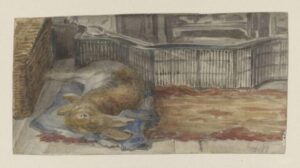
Below is one of the images I have collected thus far. I chose this image because it was not only drawn by the famous author Beatrix Potter, but it highlights the significance of pets as part of the family. This image depicts a rabbit lying on a rug, which highlights the place of the pet in the household and that pets can be more than just dogs and cats. As for the questions I want the students and viewers to answer, the first is: What is the significance of this drawing? What does this picture tell us about pet ownership during the Victorian era? What does the enclosure the rabbit is in tell us about care or affection for the animal? Similar questions about the origin of the drawing, who drew it, and how this affects the image should also be considered. In terms of how I will assist their analysis, I will provide them with the metadata and key relevant information that assists the viewers with context and significance. This drawing provides one piece in the larger picture that each exhibit teaches and shows the viewer the larger argument.

The History of History Teaching: Second Piece of The Puzzle

Now that I have had more time to reflect on my initial project ideas and think more carefully about how to teach others, particularly upper-level undergraduate students and members of the general public, about the past, I am seeing the digital possibilities of this project more clearly. My focus remains on pet ownership in Victorian Britain, a topic deeply tied to my dissertation research. However, my understanding of how digital tools can shape historical learning and interpretation has evolved.

Originally, I was torn between creating a digital exhibit using Omeka or designing a role-playing game that would allow users to inhabit the perspective of a historical actor trying to purchase and care for a pet. What I have since realized is that the most effective digital tools are those that help users actively engage with historical thinking. This means prioritizing interactivity, source interpretation, and ease of access. Even if I do not move forward with a fully developed game, I now see that incorporating game-like components into the structure of an exhibit will allow me to meet my goals while keeping the project manageable and user-friendly.

Regarding my target audiences, the best way to help them engage with digital media is through the integration of visual primary sources such as paintings, advertisements, and historical photographs. When the general public can see what they are reading about, it not only brings the past to life but also supports deeper comprehension. In a project about pet ownership, seeing historical animals and their human companions helps establish emotional and contextual connections. For students, these images can become points of entry for more analytical activities, like asking why certain breeds were popular or how pets were used to reflect class identity.

I also plan to use a timeline to orient users chronologically, which is especially helpful for those unfamiliar with the period. In addition, I am now thinking more intentionally about including question-based interactive elements. These might involve source comparison activities, classification challenges based on class or species, or reflective questions tied to specific items in the exhibit. The goal is to help students and public users alike move beyond simply consuming content to actively engaging with historical evidence and interpretation.

The biggest influence on my design choices moving forward will be usability. If I want the general public to explore this work meaningfully, the project must be intuitive and easy to navigate. This realization has shifted my project away from a complex digital game and toward a structured exhibit that incorporates the openness and critical thinking of a game within a more accessible format. In other words, I am not abandoning the idea of interaction but adapting it to work within a platform that will be more widely usable.

This shift has helped clarify my final project goals. I now envision an Omeka-based digital exhibit built around thematic sections such as“Pets and Class”  and various other themes. Ultimately, I want users to leave the site having not only learned about Victorian pets, but also having practiced historical thinking in a way that is visual, interactive, and inclusive.

The History of History Teaching

One of the many challenges in teaching history is helping students recognize that what they often perceive as static and factual is, in reality, dynamic and interpretive. This week’s readings prompted me to reflect more deeply on how external expectations, whether from school boards, lawmakers, or the public, can limit the potential of historical education. These expectations often frame history as a settled narrative rather than an interpretive process. Yet these constraints also open a space for innovation. As T. Mills Kelly and others suggest, the digital turn may offer us a way to challenge those boundaries and reimagine how we teach and learn history.

As Sam Wineburg argues, historical thinking is an “unnatural act” that requires us to “hold simultaneously the familiar and the strange” (Wineburg, 1402). This balancing act is difficult for students, who often enter the classroom believing that the historian’s job is simply to retrieve facts and that their own experiences equip them to understand the past. I see this struggle firsthand. Students perform well on “find out” questions—those based on memorization—but often falter when asked to “figure out” something complex or ambiguous. Wineburg’s research highlights that this tension is not new. As early as 1917, Bell and McCollum noted that many students “take all statements with equal emphasis” and become overwhelmed by details instead of seeing meaningful patterns (Wineburg, 1401).

Lendol Calder and Tracy Steffes describe how history education has often been shaped by the demand to produce “authorized, unchanging” stories about the past. For many policymakers and members of the public, history should “foster American national identity” through a celebratory and fact-based curriculum (Calder and Steffes, 38). This view is codified in legislation like Florida’s, which requires history to be taught as “factual, not constructed” (Calder and Steffes, 39). These pressures narrow what history education can achieve, reducing it to patriotic memorization rather than critical inquiry.

Yet the digital turn offers new ways to disrupt this model. T. Mills Kelly explains that history is not merely about the past itself but is “a way of knowing” that depends on constructing meaning from incomplete and often contradictory evidence (Kelly, ch. 1). Digital tools such as online archives, collaborative platforms, and interactive source analysis exercises allow students to engage directly with evidence and to question dominant narratives. This process helps them see that historical interpretation is not about imposing a story but about exploring multiple perspectives.

Carl Becker’s concept of Mr. Everyman reminds us that historical reasoning is not limited to professionals. People are constantly constructing their own sense of the past from fragments of memory, family stories, and public narratives (Ayers, 506). Our job as educators is to help students refine that instinct into disciplined thinking.

These readings have pushed me to reconsider how I guide students through that messy and often uncomfortable process. How do I better teach students that uncertainty is not a weakness in historical thinking, but its foundation? And how can I use digital tools to help them see themselves not as passive recipients of history, but as its active interpreters?

Thinking about Historical Thinking Portfolio Post

Of the many challenges of our profession is thinking about history and mastering how to challenge your students, and sometimes your peers, to better understand history. As Sam Wineburg states,  historical thinking is an “unnatural act,” as we must understand our biases and realize our shortcomings.  Even someone studying history in graduate school for the past four years, there is always something new to be learned or examined. It is between the two principles of viewing the past as familiar and as strange. Also, the dichotomy of empathy versus distance, using the past and being transformed by it. This week’s readings highlight the importance and complex understanding of how to view and study history. History is about conceptualizing, cooperation, learning, and critical thinking; we should not be comfortable studying history.

One of the first concepts to examine when studying or thinking historically is the concept offered in Sam Wineburg’s work on “Historical Thinking and Other Unnatural Acts,” which explores the complex understanding and practice of historical thinking. Within his work, he emphasizes three perspectives: those of a high school student, an elementary school principal, and a historian. Having grown up the child of a principal, teaching college freshmen, and working in the historical field, I feel connected to each interviewee.  Each had their unique understanding and analysis of what they saw as necessary, particularly as it connected to the subject they were evaluating. The high school student tried to apply his knowledge and empathize with the historical subject matter. With this, the concept raised that in historical thinking, “we must consider the possibility that they drew differently because they saw differently, and that there is something different about this way of seeing what is irrevocably lost.” (Wineburg 493). With the elementary school principal, Wineburg highlights the dependence that history has relied on textbooks to convey a single narrative. It has slowly crept back into our thinking, even when trying to turn away from this. Finally, the historian understood that perceived truth in a subject matter that may be well known to you will always be areas outside of your knowledge. The historian’s job is to view the past and not label it, but learn from it.

Another factor closely tied to the Wineburg article is the article by Wineburg, Smith, and Breakstone. Again, this study felt very personal to me as I have worked directly with students in an introductory survey course and upper-level history students. I have seen some of the same trends in the lack of understanding and complexity of ideas within history classes. This connects closely to figuring it out versus finding out questions. When I try to offer my students questions that require figuring out, or those that require critical thinking, they struggle. However, they do far better when I give them simple questions about finding out.

This discussion of the complex nature of studying and understanding historical thinking has created questions for me to examine throughout this class. It has also allowed me to understand better and challenge my undergraduate students.

Questions

  1. How can I help my students better understand that history is not just a static series of events but something that requires empathy and distance?
  2. What are some of the best means of teaching and sharing history? How can I get my students to emphasize and understand the figuring-out side of history?
  3. As an educator and historian, how can I convey to my students the importance and uncomfortable nature of history, and how can I learn from their ideas and conceptualizations that differ from mine?

Introductory Blog Post

Hello, everyone. My name is Lydia Pensel. I just finished my second year as a doctoral student at Southern Illinois University. I will be taking my comprehensive exams this coming fall. My main subject area of study is British history, emphasizing the Victorian era. I am also the coordinator of our undergraduate podcasting project. Besides this, I am currently working in our college’s Center for Virtual Expression, which specializes in sharing and expanding educators’ and students’ understanding of Artificial Intelligence. With this, we emphasize that AI should be used in an ethical manner and how this can be done. We also give the instructors those tools to assist their students on how not to use AI rather than their own work.

Regarding my interests in digital humanities, I have several key areas, such as using Omeka and other forms of digital scholarship to share my research and knowledge with the greater public. Since a very early age, I have loved history and wanted to share it with everyone, particularly my students as an educator. I have really enjoyed the previous courses in this program, as they have created many questions within me about how I can expand my own research to fit within digital scholarship. Some of these questions are: how can I share my knowledge of the digital humanities with my coworkers and professors so that they might better understand its use? Also, how can I use these technologies and ideas to educate my students and future students better? Overall, I have always been highly interested in technology and finding a way to merge my passion for history with my love of technology.

Regarding my goals for this class, I want to see how I can integrate aspects of the digital humanities to teach my students better. Beyond this, as someone who deals heavily with expanding and educating others on AI, I am curious about how to make things more AI-proof, as AI is not always the best option. Overall, I am just very excited about how to better understand the use of the digital humanities in my teaching. As for what types of teaching I am interested in, I am generally interested in educating everyone. Right now, I mainly focus on university education, and that is why I am pursuing my current degree. Not to mention, collaboration with coworkers is also important. But, as last semester’s class shows, I am also interested in educating the general public to understand history and its importance better, and I wish to share my knowledge with the world.

I look forward to collaborating and learning with all of you this semester!

Blog Post on Process

As we begin wrapping up this course, it makes me consider what I learned. This course shifted the way I think about historical work entirely. What started as something unfamiliar quickly became an opportunity to explore new ways of sharing history through accessible, creative, and engaging public platforms. Designing and building a digital prototype showed me that history is not just found in books or archives. When paired with thoughtful design, people can interact with it directly, inviting participation rather than just observation.

Building the prototype required me to think beyond my usual role as a historian. I had to consider the responsibilities of a curator and communicator as well. Every decision, from structure to audience to visual layout, had to be made with clarity and accuracy. That balance was not easy to strike, but it forced me to develop a new set of skills that I now see as essential for historians working in the present day. Turning complex historical material into something open and engaging for the public was more complicated than I expected, but ultimately more rewarding. Making history accessible does not mean simplifying it. It means meeting people where they are.

What also stood out to me this semester was how much digital public history is shaped by collaboration and ethical decision-making. The course pushed me to think carefully about which narratives are told, whose voices are included, and what responsibilities come with sharing history in public spaces. I will continue to ask these questions in future work. More than anything, this course expanded how I define historical practice. Public engagement is not an afterthought or a side project. It is a key part of the historian’s work. I leave this class with a finished project and a more profound sense of purpose in making history matter beyond academic spaces.